 |
| Lionel Messi |
For many, if not the majority of football fans, diving is seen as one of the game's true evils. Along with greedy owners, 'anti-football' defending and Sepp Blatter, simulation is aggressively frowned upon, especially in the UK. We know that in many other countries and football cultures, the ability to draw a foul where there was none is almost seen as an art form; a skill that is to be utilised as much as a step-over or body feint. Present such a theory to British football supporters and it will most likely be dismissed as cynical and poor sportsmanship. Whether you lean one way or the other, there is no doubt that the issue of diving is ever-present. The act is evident in almost every match you watch, whatever the level, country or competition, of that there is no escape.
However, when pundits, journalists and fans debate and discuss this issue, are they more often than not missing the point? Certainly, questions have to be asked of a player's level of sportsmanship or his moral compass when trying to fool the referee into thinking he has been fouled. Even more so if that is followed up by the often-seen rigorous attempts to have his opposite number booked or sent off. However, when compared with other problems that plague the game both domestically and across the world, there's an argument to be made that diving is sinking lower down the list. I am not going to suggest that we embrace the art of diving or attempting to get a opposition player penalised, but it is worth making the argument that of all the sins we witness in professional football, it does not warrant the level of scrutiny that the media gives it.
Firstly, let's look at the other problems that football has to deal with; whatever the level, whatever the league. In the Premier League in recent seasons, much has been made of dangerous tackling, resulting in several serious injuries. We all know of the horror tackles that have caused severe damage to the likes of Eduardo da Silva, Aaron Ramsey and Hatem Ben Arfa. Eduardo, then of Arsenal, was side-lined for almost a full year after suffering a broken left fibula and an open dislocation of his left ankle after a high challenge from Birmingham City's Martin Taylor. Ramsey, also of Arsenal, was the victim of a over-zealous tackle from Stoke City's Ryan Shawcross that left the young Welshman with a double-fracture to his lower right leg; keeping him out of action for 9 months. Newcastle United's Hatem Ben Arfa broke both his left tibia and fibula through a challenge from Manchester City's Dutch midfielder Nigel de Jong and was unable to return to action for 10 months.
 |
| Hatem Ben Arfa |
I could fill this entire blog with similar examples from across Europe and in the English Premier League it's getting to the stage where we're almost guaranteed at least one serious injury per season. Now clearly, due to the nature of football and especially in England where the pace of the game is arguably quicker and more dynamic than any other top league, collisions and strong tackles are to be expected. But it is incredibly difficult to exonerate a player from responsibility using that as an excuse. We see dozens of examples of good sliding tackles every week across the country, where players are able to dispossess an opponent and win the ball back through a combination of athleticism and good technique. Unfortunately in the UK, media pundits and a large proportion of supporters are happy to allow these poor tackles to continue to be part of the game. Passing it off as an act of passion and determination, rather than filled with any malicious intent.
It only takes a few minutes to find examples of dangerous tackles that are clearly malicious and designed not only to impede a fellow player, but to hurt them too. Roy Keane, Steven Gerrad, Patrick Vieria and Michael Essien have all been guilty of committing to dangerous tackles, in the knowledge that it only requires the victim to be standing in a certain position or for his studs to get caught in the turf to cause serious damage. I am not trying to suggest that slide tackling has no place in modern football, it most certainly does; but tackling should be viewed as a art, a piece of skill akin to that of good passing or close-quarter dribbling. A well-timed tackle is entertaining to watch and excites fans, but should first and foremost look to win the ball and regain possession for that individual's team.
 |
| The art of tackling |
So surely bad tackling is a bigger issue than diving? I'm sure from a football perspective; fans would be less annoyed to see a player on their team go down under minimal contact than to throw themselves into an ill-fated two-footed challenge. The punishments would echo such a statement; rather a yellow for attempting to con the referee than a red for attempting to break a leg. Some may say it is a case of over-enthusiasm, but these players are professional and many who commit such tackles are vastly experienced. The excuse that an individual is 'not that kind of player' is usually immediately contradicted by the video evidence we see from out on the pitch.
The governance of world football has arguably never been under more scrutiny. The corruption scandal that has engulfed football's world governing body, FIFA has cast a deep and dark shadow over the game as a whole. Allegations of bribery concerning high-ranking officials at Sepp Blatter's organisation has led to multiple suspensions and fines for several football administrators, as well as a life-time ban for former Asian Football Confederation (AFC) President and FIFA Executive Committee member, Mohammed bin Hammam. Bin Hamman, who was due to run against current FIFA President in the 2011 Presidential elections, was found guilty of attempting to bribe members of the Caribbean Football Union (CFU) in the run-up to the vote.
Considering these men are at the highest level within the largest organisation that governs football, it must surely be considered as the most pressing issue with regards to the future of the game. I am not suggesting that the majority of football fans are more concerned with the on-field antics of players than this, rather than when taking into consideration the true impact that an issue such as a diving has, it is worth comparing it to the larger picture with the world of football.
 |
| Guilty |
Finally, and there is a danger of this becoming a running theme throughout these blog articles, there is the issue of poor football. By 'poor football' I do not mean dull 0-0 draws and match's void of chances and goalmouth action. By 'poor' I mean low quality football; be it a lack of technique, inaccurate passing, little creativity or team's bereft of organisation and tactical acumen. To many, the more goals scored, the better a match becomes. Fans like to see goals, chances and controversy. But do goals always equate to high quality? Liverpool's famous 4-3 victory over Newcastle United in the Premier League during the 1995-1996 season was voted the Premier League's 'Match of the Decade'. There is no denying that it was an incredibly exciting match and no one would surely have failed to be entertained throughout the 90 minutes, but was it a football match of the highest quality? Watch it again and it is peppered with poor defensive play; a lack of organisation and positional intelligence that led to the majority of the 7 goals. Robbie Fowler is unmarked for Liverpool's first goal after 2mins, Liverpool's backline is caught ridiculously high up the pitch in conceding to David Ginola as Newcastle go 2-1 ahead, Asprilla's excellent finish to give Kevin Keegan's men a 3-2 lead is facilitated considerably by an absolutely woeful Liverpool backline that is all over the place and finally Collymore's late winner is virtue of Newcastle's entire defence being drawn to the ball, giving the forward ample time and space to finish.
So whilst it was exciting, the quality certainly left alot to be desired and is arguably a source of concern for British football. There is nothing wrong with enjoying football for the excitement and goals, but in terms of British teams, both at club and national level catching up with Spain, Germany, Brazil etc., it is important to highlight that the level of technique and skill is lagging behind the world's leading football powers.
What may be an interesting theory for consideration is that in order to improve the quality of football, especially in a technical aspect, simulation and other unsavoury behaviour may have to be tolerated. Certainly in Britain, skilful, gifted players do not get enough protection off the referees. Over-zealous tackling is usually tolerated and often commended. Look no further than Alan Shearer's deplorable chuckling when reviewing Karl Henry's brutal hatchet job on Joey Barton at Molineux last season. Whatever you think of Barton and he isn't the most popular of professionals, Henry's tackling, both late and malicious, was disgusting and counter-intuitive to high-quality football.
 |
| Tolerated |
It is almost impossible to cover every facet of this issue on one blog entry. There are so many caveats to address you could almost write a thesis on it. FC Barcelona are held up as the model for modern football teams, mostly for the quality and style of their play. The intricate passing moves that are witnessed almost every match at Camp Nou, whoever the opposition, are arguably the zenith of modern day football. Some clubs around Europe have adopted a similar approach to differing levels. Arsenal are an obvious example, but teams such as Wigan Athletic, AS Roma, Borrusia Dortmund and Ajax all play in similar style and in some cases have cited the current Catalan side as inspiration. Anyone that witnessed Dortmund's opening day 3-1 win at home to Hamburg would have been able to draw comparisons; especially the quick passing and complex movement epitomised by Mario Götze and Shinji Kagawa.
From a personal perspective, I cannot understand why many fans are so dismayed at players trying to win free-kicks and gain similar advantages. Surely this is akin to a player claiming for a throw-in for his side when he knows that he was the last player to touch the ball. Compared to many of the issues discussed above, it seems odd that so many would maintain this level of concern for a rather meaningless issue. Certainly, if you could guarantee its complete eradication then there would be universal approval, but in the mean time the focus should shift to the referees. Officials are certainly more competent than ever before in terms of picking up these offences, but on many occasions we see referees acknowledge an act of simulation, but wave play on, failing to return and issue a yellow card to the offender. A tough, zero tolerance approach would surely help to at least tone down the frequency of these incidents. However, if governing bodies believe that officials would be better served focusing on other more pressing matters, such as dangerous tackling, then by all means do so, and in turn accept that diving has been a part of professional football for generations, despite what nostalgic-infested, history dwellers may perpetuate.
 |
| Better times... |
If you are of a certain age, then during the 1990's most of your Saturday and Sunday mornings will, or perhaps should, have been spent in front of the television watching the magnificent Football Italia on Channel 4. The outstanding James Richardson, now of The Guardian's Football Weekly podcast, presented the show with an infectious enthusiasm and rich knowledge, complimented by his fervent wit and excellent taste in continental deserts.
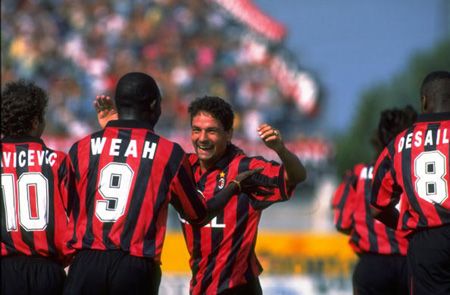
For those who regularly watched Italian football throughout this period, it was hard to disagree that it was Europe's top league. Although the likes of Eric Cantona, Alan Shearer, Rivaldo and Luis Figo were playing in England Spain respectively, Serie A had the likes of George Weah, Roberto Mancini, Ronaldo and Zinedine Zidane playing every week. In fact, from 1990 to 1999, Serie A-based players won 6 Ballon d'Or awards; Lothar Matthäus (Inter) 1990, Marco van Basten (Milan) 1992, Roberto Baggio (Juventus) 1993, George Weah (Milan) 1995, Ronaldo (Inter) 1997 and Zinedine Zidane (Juventus) 1998.
Since 2000, and the unfortunate demise of Football Italia from our screens, there has been an evident drop in interest in Serie A. The Calciopoli scandal in 2006 certainly hasn't helped matters; the suspicions that arise from match-fixing allegations tend to stick for a considerable length of time. However, as has been seen in Germany and Turkey in recent years, this problem isn't exclusive to the Italian game and although it may have a greater pedigree in Calcio then any other major European footballing country, it would seem unfair to completely dismiss one of the continents greatest domestic leagues on just this basis.
 |
| Simply Divine |
So what other reasons are there in trying to explain Serie A's fall from grace? The most obvious, especially when pouring over the list of great names above, would be a lack of truly world-class talent. The world's greatest players currently ply their trade in either Spain; Lionel Messi, Xavi Hernandez, Cristiano Ronaldo, or England; Wayne Rooney, Carlos Tevez, Robin van Persie and some of the talented, young players in Serie A have already left this summer; Alexis Sanchez to FC Barcelona and Jeremy Menez to PSG.
This is all relative however to what you expect and look for when watching football. Much has always been made of the cultural differences across different league in Europe and beyond. England is perennially seen as a physical division, where hard-work and intense atmospheres define the football that is played. La Liga in Spain places greater emphasis on technique and ball retention; something that the national team has mastered, adding the 2010 World Cup to their European Championship triumph in 2008. Italy however appears to attract more negative stereotypes; defensive, dull, slow football, played in front of half-empty, decrepit stadiums.
While no doubt I will address the issue of instantly defining defensive football as dull soon enough, it is important to look beyond these dated and stale preconceptions and analyse what Serie A has to offer in the 'post-Football Italia' world. It does not take long to establish a lengthy list of top-class players currently on the books at the league's biggest teams. Zlatan Ibrahimovich, Robinho and Alexandre Pato at AC Milan; Wesley Sneijder, Lucio and Maicon at Internazionale as well as the likes of Francesco Totti, Marek Hamšík, Miloš Krasić and Antonio Di Natale all featuring. Certainly then, if you're looking hard enough, the quality is there and Internazionale's Champions League win in 2010 proves that the league's best can match what Europe has to offer.
 |
| Kings of Europe |
As has been mentioned previously, some of the more talented youngsters are on their way out and Udinese's sale of Alexis Sanchez to Barcelona is disappointing from a pro-Serie A point of view. However, it does show that the country is capable of nurturing young players to such a high level. Sanchez aside, there is still a plethora of emerging players and not just within the league's hierarchy. Stevan Jovetić at Fiorentina has been unlucky with injuries recently, missing the entire 2010/2011 season through a serious knee problem, but has performed well both domestically and in the Champions League when fit; including his 2 goals at home to Liverpool during the 2009/2010 Champions League group stage. Sebastian Giovinco is finally beginning to show his true worth at Parma after struggling at Juventus; scoring 7 goals last season, and the exciting Erik Lamela has joined AS Roma from Argentine side River Plate this summer.
So the talent is certainly there, at both ends of the age range. There also appears to be a variety of player types; dispelling the myth that Italy continues to be dominated by defensive-minded and laborious individuals; socks down to the ankles, offering exquisite technique and passing, but severely lacking in the kind of dynamism that has come to epitomise the English Premier League. Perhaps then it is a case of exposure. As I touched upon at the start, the main reason Serie A was so popular in the 90's in the UK was the success of Football Italia. For many casual football fans, if certain leagues aren’t readily available on television, then they are not inclined to go searching for it. Although live internet streaming, whether legitimate or not, has become a more prevalent form of following foreign leagues and competitions, not many are so keen that they will regularly indulge in laptop viewing; especially due to the lacking social appeal that crowding around a television provides.
However, in the UK, the rights to broadcast Serie A matches have been held by ESPN since 2009, which although not a freeview channel, is readily and cheaply available to almost everyone. The season before (2007-2008) Channel Five held the rights, a station that is immediately available to all. It could be argued that since Football Italia on Channel 4 stopped, the rights have shifted amongst too many broadcasters on too regular a basis to maintain interest; Eurosport, Setanta Sports and Bravo all showed Serie A matches between 2002 and 2007. Perhaps it is that 5 year period that accelerated the decline in interest in the UK. Some may argue it is the quality of the football, but Sky Sports subscribers regularly tune in to watch Stoke City vs. Wigan Athletic and Wolverhampton Wanderers vs. West Ham United, which with the greatest respect, does not showcase the level of technique and ability that can be seen regularly in Italy.
 |
| Really?! |
Maybe then it is just sheer laziness. So many casual football fans profess to being knowledgeable about European and World football. Ask a supporter on the street about any particular team or player and they will usually have some sort of opinion on them. They are always the first to react on club forums and Sky Sports News to latest signings, whether they have come from a domestic club, or a mid-table Russian Premier League club. You know what you're getting when your club signs Jason Roberts; "Works hard, puts in a shift, he'll do a job" and what about new Rangers F.C. defensive signing, Dorin Goian; "Works hard, good in the air, he'll do a job". I may be wrong, but I imagine the majority of Govan's finest didn't see many of Goian's 36 appearences for Palermo since 2009. I must confess that I know little of him too; my experience of seeing him play limited to his two appearances for Romania in the group stages of Euro 2008. This may feel like I’m straying a little far off course, but the point being that it is foolish to dismiss an entire league, especially one with the heritage of Serie A, just because little attention is paid to it.
The 2011/2012 Serie A season promises to be more exciting than we've seen in many years. The Internazionale domination of the division since 2006 did little to generate interest and Milan's title victory last season wasn't a huge diversion from the norm, but there is much to look forward to over the coming months:
Juventus are certainly stronger; picking up Andrea Pirlo on a free transfer after his contract expired at AC. Joining him in the central midfield region will be the Chilean, Arturo Vidal, who starred for Bayer Leverkusen last season and is a great piece of business, costing the Turin club just €10.5m and if Fabio Quagliarella can stay fit, then Juventus will have that cutting edge that they so desperately lacked last term.
Champions AC Milan, who were considerably bolstered half-way through last season by the signing of Mark van Bommel, have added greater solidity this summer, with two excellent free signings in French defender Philippe Mexès and Nigerian left-back Taye Taiwo. A central defensive pairing of Mexès and the excellent Thiago Silva is enough to get any football fan excited. The attacking merits of Milan are well documented and whilst there is some doubt over the future of Antonio Cassano; possibly a makeweight in a deal to bring Fiorentina midfielder Ricardo Montolivo to the San Siro, there still remains Robinho, Zlatan Ibrahimovic, Alexandre Pato and Filippo Inzaghi, as well as the mercurial Stephan El Shaarawy, a purchase from Genoa.
 |
| Philippe Mexes |
Milan's city neighbours, Inter, who improved immeasurably in the second half of last season after sacking Coach Rafael Benítez, appear well placed to mount a more consistent title challenge this season, as they seek to regain the dominance they forged in the wake of the Calciopoli scandal. Despite much being made of their relatively ageing squad, the Nerazzurri have so far made only moderate additions to their sizeable squad. Ricardo Álvarez has been signed from Vélez Sársfield despite stiff competition from Arsenal and 25 year-old Brazilian defender Jonathan Cícero Moreira has joined from Santos. They may have lost Emiliano Viviano for most of the season due to a tear of his anterior cruciate ligament, but with Júlio César in goals have little to worry about. Adding another forward must surely be the priority and inevitably Carlos Tevez is top of most rumour lists. The issue is not whether Tevez would be a worthy addition, that much is in no doubt, but if Inter have the funds in place. A loan deal seems unlikely, due to Manchester City's desire to cover the cost of Sergio Agüero.
Napoli will be looking to build on an impressive campaign in 2010/2011, where the goalscoring exploits of Edinson Cavani led them to a 3rd place finish and direct entry into this season's Champions League group stages. Gökhan Inler is an excellent capture from Udinese, but more crucially for the Partenopei will be keeping hold of last season's stand-outs. As well as Cavani, Marek Hamšík, Walter Gargano and Ezequiel Lavezzi are crucial if the Naples men are to make an impact in the Champions League.
Inler's former employers Udinese are perhaps in the weakest position of last season's top 7 to improve on their excellent 4th place finish. In Inler, Alexis Sánchez and Cristián Zapata they have lost three of their most influential players throughout the pitch. They have kept hold of Antonio Di Natale and much will be depend on his performances if Udinese are to make it back-to-back top four finishes next May. Francesco Guidolin will also be hoping that the likes of Paulo Vitor Barreto, re-signed after a spell at A.S. Bari, amongst others will help fill the void left by Sánchez. Despite these concerns, the sale of Inler, Sánchez and Zapata has brought in €51m, which may well be re-invested in the squad before the end of August.
Finally, the two Rome clubs; A.S. Roma and Lazio. Roma, who finished a disappointing 6th last term, have been interesting viewing over the summer. The Argentine attacking-midfielder, Erik Lamela has joined from River Plate and Bojan Krkić has arrived from FC Barcelona in a complex deal that will see the young Spaniard stay with i Giallorossi for two seasons, after which the Catalan club are obliged to buy him back for €13m. Roma will have the opportunity to purchase Bojan outright, but for an additional €28m. Dutch No.1 goalkeeper Maarten Stekelenburg is expected to sign in the coming days, after Brazilian 'keeper Doni was allowed to leave for Liverpool FC.
Lazio have also been busy during the off-season. Néstor Muslera, who has joined Galatasaray, was swiftly replaced by Federico Marchetti from Cagliari. The Italian international goalkeeper is joined by fellow new-starts Djibril Cissé, Lorik Cana, Miroslav Klose and Marius Stankevičius. Added to an already strong squad with the likes of Hernanes and Mauro Zárate, Lazio would appear to be in good health as the new Calcio season draws ever nearer.
 |
| 2011 Champions Milan |
It would be a great surprise if the 2012 scudetto winners were not one of the above. Fiorentina may be potential dark horses, though losing Montolivo would be a huge blow to their slim chances. Cynics may suggest that it will again become a two-horse race between the Milanese clubs; however Serie A will arguably be the most open major league in Europe this season. England, Spain and Germany have 2-4 possible championship winners at best and many other leagues, such as Portugal and Russia will potentially have runaway winners.
At a push, I would have to back Milan to retain their crown this coming season. They have maintained their strong forward line from last season and have addressed some long-term concerns at the back, with Mexes being a particularly excellent addition. Lazio have strengthened too and could well finish in the Champions League places next season, edging out Napoli and Roma. I expect Juventus to be much stronger than the previous campaign and although they have again chosen an inexperienced manager in Antonio Conte, they had made solid signings and if they keep their key players fit, should make the top 4.
So this season, instead of immediately dismissing Serie A as a boring and potentially corrupt league, embrace everything it has to offer. For the first season in many a year, we could be looking at possibly 4 or 5 teams battling for the championship come spring time. They're are world class players wherever you look; Ibrahimovich, Totti, Cavani, Krasić, Pato and more than enough off-field drama to last a few seasons over! ESPN is only a few quid a month, so there's really no excuse. If like me, you're keen on expanding your footballing horizons and looking for another league to love. Love Calcio.
I thought it appropriate for the first blog entry to offer an insight into what to expect for my current 0 readers. I'm sure in time people will start to follow it, but need to give them something interesting to read!
I should perhaps begin by explaining the title; 'Chocolate From Distance'. I have to admit, this was not of my own creation, but a phrase that a friend of mine used during a discussion on players who happened to be very good at long-distance shooting. Considering the vast amounts of football blogs currently floating around, an original title was of paramount importance.
Over the coming weeks i'll start to populate the site with articles on a wide-range of footballing issues, attempting to cover as many different countries, leagues and stories as possible. I will make a conscious attempt to avoid focusing on the bigger, more popular stories and provide a well-balanced range of topics to discuss and debate upon.
As for what to expect specifically; my own, personal interest in football is vast and i'll look to publish articles on certain players, teams and competitions, as well as offering my own insights into the political, organisational and tactical aspects of football.
Hope you enjoy...or at least read.


